
Transparent with you: An illustrative example, put together from situations we come across with regional teams in Singapore. It isn’t the story of one particular Rudlyn client.
Picture a software company with its regional office on the edge of the CBD. Marketing for Singapore, Malaysia, Indonesia and the Philippines all runs from that one floor, through one HubSpot account. The person who built that account handed in her notice in March. By August her role was still open.
For five months the company paid for an enterprise licence that no one had time to look after properly, and kept emailing people it couldn’t prove had signed up. In the end the Head of Regional Marketing stopped waiting for a local hire. A dedicated Rudlyn specialist was working in the account about five weeks after their first conversation.
Case study at a glance
| Field | Value |
|---|---|
| Company | B2B software, around 250 staff, regional office in Singapore |
| Markets | Singapore, Malaysia, Indonesia, the Philippines |
| Platform | HubSpot Marketing Hub Enterprise, linked to Salesforce |
| Starting point | Five months without an owner, a broken Malaysian demo form and thousands of contacts with no consent record |
| Who joined | One full-time marketing automation specialist, chosen by the Head of Regional Marketing |
| Time to start | About five weeks (Rudlyn’s usual range is 4 to 6) |
Four markets, one inbox of requests
Country managers in Kuala Lumpur, Jakarta and Manila didn’t touch HubSpot themselves. They sent briefs to Singapore, and Singapore built the emails, landing pages and forms. It’s a sensible way to run a region. It also means everything stalls when the one person who knows the account leaves.
Nothing dramatic happened after she left. Small things went wrong and stayed wrong.
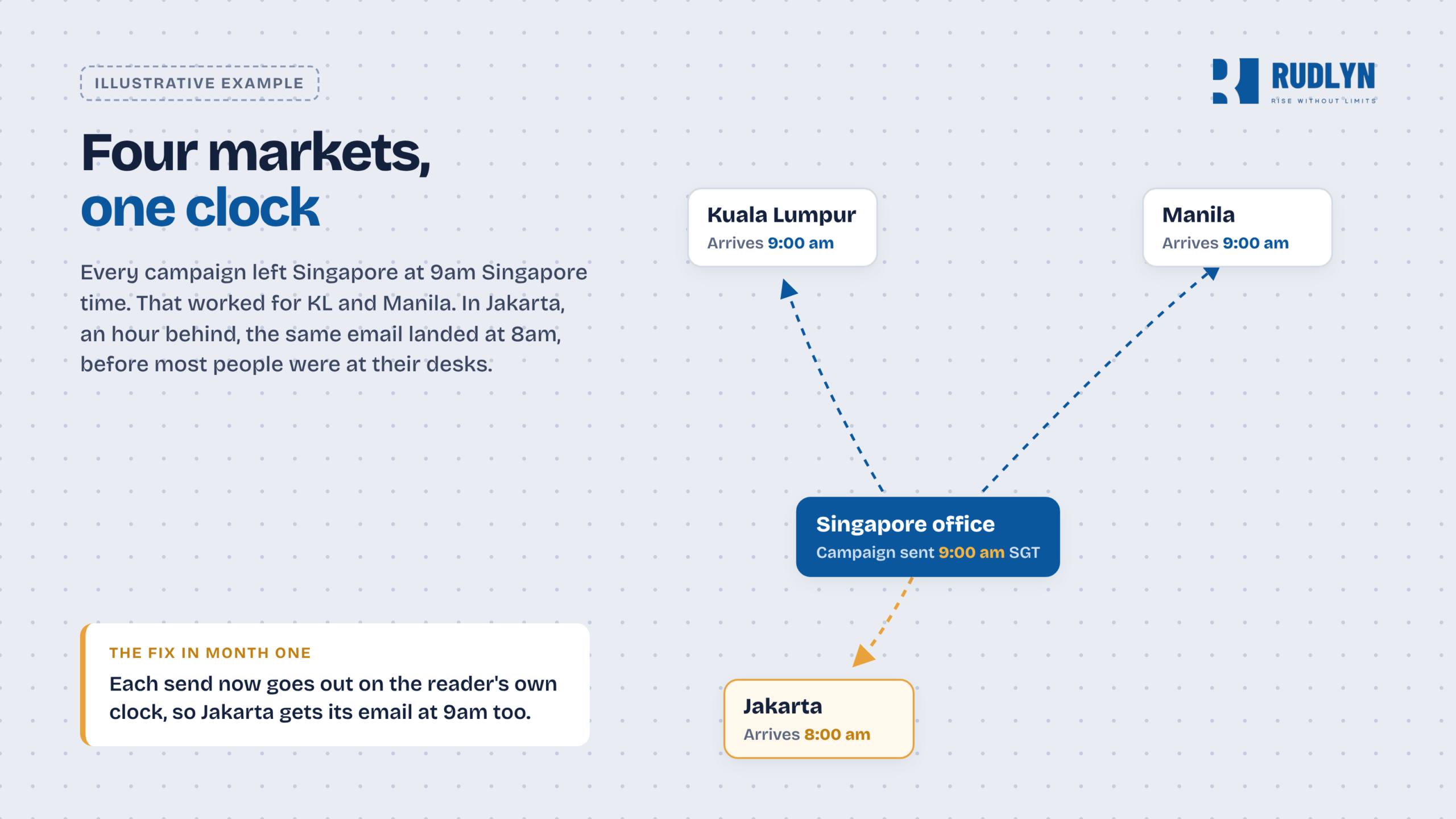
- Every campaign was still scheduled on Singapore time, so Jakarta’s “9am” emails were arriving at 8am.
- Someone renamed a field on the Malaysian demo form. The routing rule depended on it, and for about six weeks Malaysian demo requests sat in a general queue that the KL sales team never checked.
- Three years of event and webinar imports had piled up across four countries. A large share of those contacts had nothing on file to say how or when they’d agreed to hear from the company.
- Lead scores hadn’t been adjusted in over a year. Sales had quietly stopped opening the alerts.
A local agency was brought in to keep the lights on. They were quick with tickets. But each ticket was a separate job, and nobody was looking at how the pieces fitted together.
Why the Singapore search dragged on
The job ad asked for enterprise HubSpot, hands-on Salesforce experience and campaigns run across more than one country. Plenty of people had one or two of those. Very few had all three, and the two who did were offered more money to stay where they were.
Then there was the budget. For a sense of the market, Morgan McKinley’s 2026 salary guide lists senior digital marketing managers in Singapore at roughly S$100,000 a year in the 5 to 10 year bracket, rising to about S$150,000 beyond that. It’s a broad category, so the right number for this exact role could sit either side.
The base salary was only where the bill started. Here’s what else a local hire would have added:
| Item | Rough impact |
|---|---|
| Employer CPF | For a Singaporean or PR employee aged 55 or under, 17% of monthly pay, counted on the first S$8,000. At that cap it comes to S$1,360 a month, or S$16,320 over a year, with bonuses on top. |
| Recruiting | Either an agency fee or weeks of a recruiter’s time, plus several rounds of interviews for the marketing and sales leads |
| Waiting for them to start | An accepted offer still means waiting out the candidate’s notice period |
| Getting them set up | Laptop, software licences, benefits and the time it takes someone to learn a messy account |
None of that counts what the vacancy itself was costing: another month of the problems listed above, every month the seat stayed empty.
From first call to first login in five weeks
The Head of Regional Marketing had two conditions. She wanted one person in the account every day, someone who’d know it as well as her old ops lead did. And she wasn’t prepared to sit through another round of job boards.
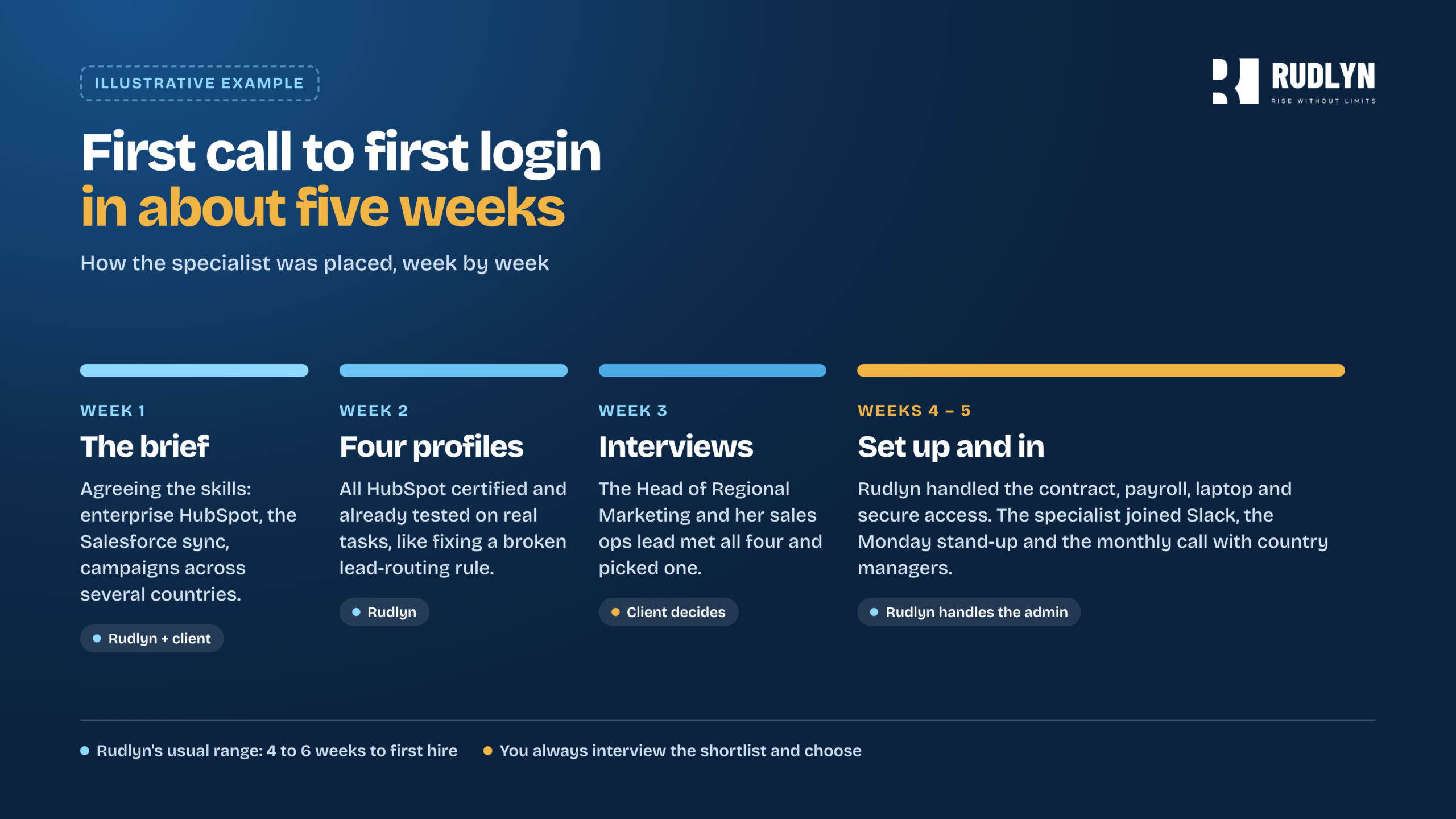
- Week 1. A call with Rudlyn to pin down the role: HubSpot at enterprise level, comfort with the Salesforce sync, and experience juggling campaigns for several countries at once.
- Week 2. Four profiles arrived. All four were HubSpot certified, and each had already been tested on practical tasks, one of which was untangling a broken lead-routing rule.
- Week 3. She and her sales ops lead interviewed all four and picked one. The choice was theirs.
- Weeks 4 and 5. Rudlyn took care of the contract, payroll, laptop and secure access. The specialist was added to Slack, the Monday campaign stand-up and the monthly call with the country managers.
On paper, the specialist is a Rudlyn employee in India. Day-to-day, they report to the Head of Regional Marketing and work on nothing but her account. India is two and a half hours behind Singapore, so most of the working day overlaps. A brief sent from KL before lunch usually gets picked up the same afternoon.
That’s the arrangement in one line: your team, our infrastructure.
Sorting out consent under PDPA
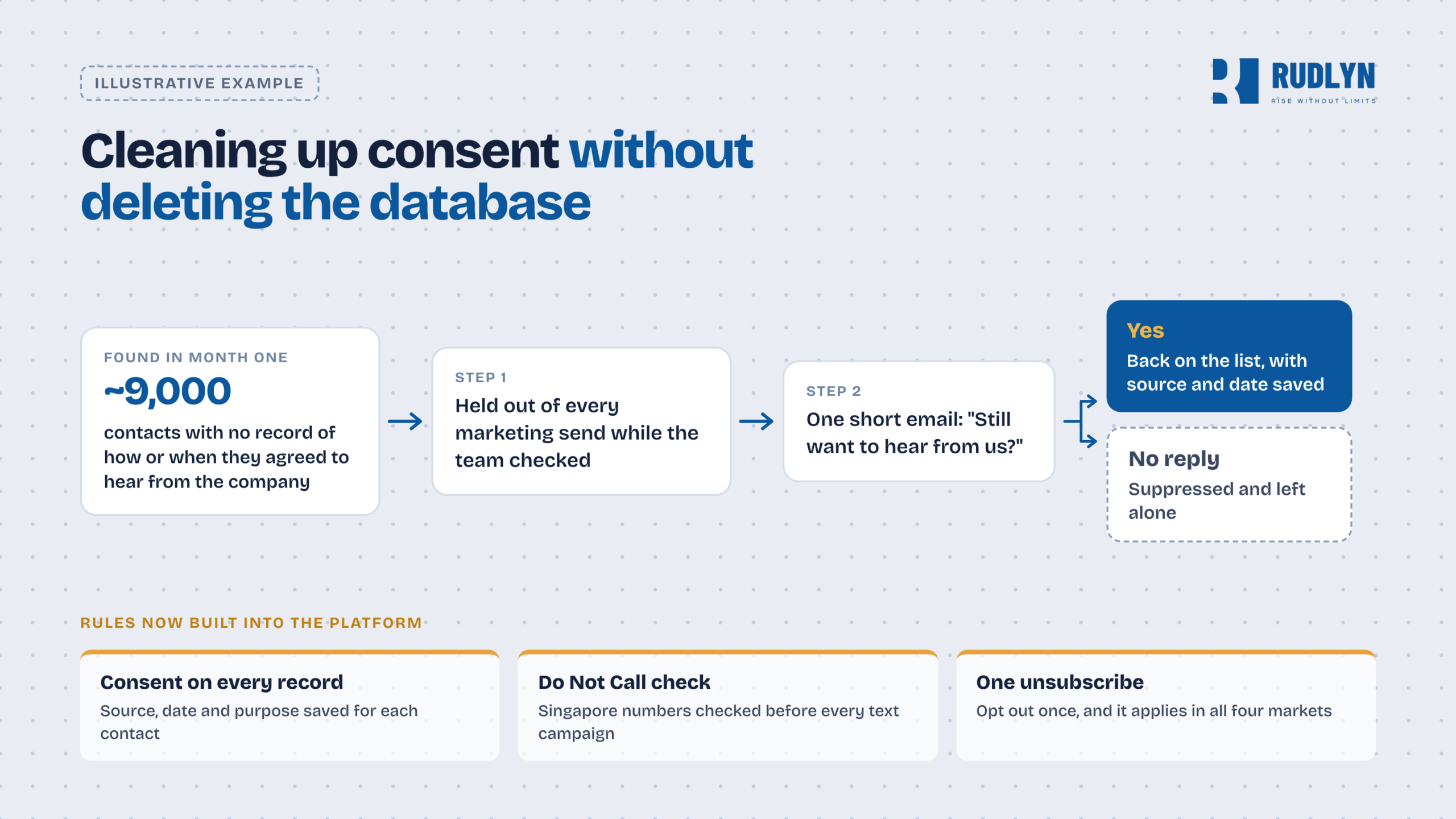
The broken form was annoying. The consent gap was the part that kept the Head of Regional Marketing up at night. Roughly 9,000 contacts, mostly from Singapore and Malaysian events, had no source, no date and no record of what they’d agreed to receive.
Singapore’s Personal Data Protection Act (PDPA) expects a company to have consent before using personal data for marketing, to say what it’s for, and to stop when someone asks. Marketing calls and texts to Singapore numbers carry an extra step: the number has to be checked against the Do Not Call (DNC) Registry first, unless the person has given clear consent that’s been recorded.
The specialist sat down with the company’s data protection officer and worked through it in this order:
- Added fields for consent source, date and purpose to every contact, and held anyone without them out of marketing sends.
- Sent one short, plain email to the held-back group asking whether they still wanted to hear from the company. Those who said yes went back on the list. Everyone else was suppressed and left alone.
- Set up a DNC check on Singapore mobile numbers before every SMS campaign, repeated on a schedule, since a check doesn’t stay valid forever.
- Joined up the unsubscribe settings, so someone who opts out of a Manila webinar invite is opted out across all four markets.
All of this happened inside the company’s own HubSpot and Salesforce, using logins the company controls. No contact lists went into spreadsheets on someone’s laptop. The data protection officer still owns PDPA compliance. What changed is that the platform now follows her rules on an ordinary Tuesday, as well as on the day of an audit.
General information only, not legal advice. Your data protection officer and the PDPC’s DNC guidelines are the right places to confirm what applies to you.
How the first three months went
Rudlyn specialists work to a 30-60-90 day plan. In this case that meant a month of learning the account, a month of clean-up and a month of building.
Month one: get to know it, fix the obvious
The specialist spent the first fortnight reading before touching anything. They made a spreadsheet of every workflow, form, list and Salesforce sync rule, with a column for which country each one served. Two quick fixes came out of it. The Malaysian form was repaired in week two, and every scheduled send was moved to the recipient’s local time.
The spreadsheet also showed 38 of 110 live workflows hadn’t enrolled a single contact in six months.
Month two: consent and tidy-up
Most of the consent work described above happened here. Alongside it, duplicate records were merged and the country and industry fields were cleaned, which finally let the team report on Indonesia and the Philippines separately.
Month three: new work
The specialist sat with sales ops and the country managers to agree what a good lead looks like in each market, since a promising lead in Manila didn’t look quite the same as one in Singapore. Scoring was rebuilt around those answers. Two programmes went live before day 90: an onboarding series in Bahasa Indonesia for new Jakarta customers, and a renewal reminder sequence for Singapore accounts coming up to their contract date.
Where things stood at day 90
| Then | Day 90 |
|---|---|
| Nobody in charge of the account | A named specialist at every campaign stand-up |
| 38 workflows running for no one | Each one either switched off or given an owner |
| About 9,000 contacts with nothing on file | A source, date and purpose recorded for everyone still being marketed to |
| Every send on Singapore time | Each market receives email at its own local time |
| Sales skipping lead alerts | Country sales teams acting on them again |
| Agency on retainer for everyday fixes | Retainer ended; the agency still does the occasional design job |
The company didn’t buy any new software. It already had what it needed. What it was missing was someone whose whole job was to look after it.
If the search for a marketing operations lead has run longer than you’d like, or you’re not sure your consent records would hold up if someone asked, we’re happy to talk it through. Have a look at how Rudlyn’s dedicated teams work in Singapore or book a call with us.